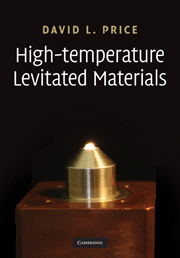
High-temperature levitated materials /
"One of the major experimental difficulties in studying materials at extreme temperatures is unwanted contamination of the sample through contact with the container. This can be avoided by suspending the sample through levitation. This technique also makes metastable states of matter accessible, ope...
Saved in:
| Main Author: | |
|---|---|
| Format: | Book |
| Language: | English |
| Published: |
Cambridge ; New York :
Cambridge University Press,
2010.
|
| Subjects: | |
| Online Access: |
Online Access |
| Summary: | "One of the major experimental difficulties in studying materials at extreme temperatures is unwanted contamination of the sample through contact with the container. This can be avoided by suspending the sample through levitation. This technique also makes metastable states of matter accessible, opening up new avenues of scientific enquiry, as well as possible new materials for technological applications. This book describes several methods of levitation, the most important being aerodynamic, electromagnetic and electrostatic. It summarizes the state-of-the-art of the measurement of structural, dynamic and physical properties with levitation techniques, the considerable progress made in this field in the past two decades, and prospects for the future. It also explores the concepts behind the experiments and associated theoretical ideas. Aimed at researchers in physics, physical chemistry and materials science, the book is also of interest to professionals working in high-temperature materials processing and the aerospace industry"--Provided by publisher. |
Internet
Online AccessAnnex
| Call Number: |
TA 417.7 .H55 P75 2010
|
|---|---|
| Available Request Request a scan of an article or book chapter |